

A sworn translation (tłumaczenie przysięgłe) is an official translation produced by a translator registered with the Polish Ministry of Justice, and it carries legal validity for Polish courts, notaries, government offices, and most universities. The single most important step you can take right now: check the Ministry of Justice register before hiring anyone.
Immediate next steps:
- Check the Ministry of Justice register to confirm the translator is listed and active
- Confirm with the receiving body (court, voivodeship office, university) that it specifically requires a sworn translation and whether it accepts an electronic version
- Request a written quote that includes the translator's TP registration number, price basis, turnaround, and delivery format
Always use a translator listed on the Ministry of Justice register. Documents translated by anyone else will almost certainly be rejected by Polish authorities.
Key Takeaways
A sworn translation in Poland is only legally valid when issued by a translator on the Ministry of Justice register — verifying that registration number is the single step that prevents most rejections.
| Point | Details |
|---|---|
| Verify the requirement first | Confirm with the receiving body whether it needs a sworn translation and whether it accepts electronic format. |
| Check the Ministry register | Search the official register by name or language pair and confirm the translator's TP registration number. |
| Request a written quote | The quote must state price basis, turnaround, delivery format, and the translator's TP number. |
| Send complete originals | Include all stamps, annotations, and attachments — missing content causes delays and noted gaps. |
| Regalconsultancy coordinates logistics | Regalconsultancy arranges quotes, delivery, and authority confirmation; the registered sworn translator issues the certified document. |
Table of Contents
- What is a sworn translation in Poland?
- Which institutions accept sworn translations in Poland?
- Step-by-step: how to obtain a sworn translation in Poland
- Where to find sworn translators and how to verify their credentials
- Typical pricing and turnaround for sworn translations in Poland
- Common mistakes and red flags when ordering sworn translations
- Electronic sworn translations and qualified electronic signatures
- How to prepare documents for a fast, error-free sworn translation
- The part of this process most people get wrong
- Regal Consultancy's translation coordination service
- Sources
What is a sworn translation in Poland?
In Poland, a sworn translator is a state-authorized professional who has passed a state exam and been entered on the Ministry of Justice register. This is not a voluntary certification or a self-declared credential. The profession is governed by the Act on the Profession of Sworn Translator, which sets out obligations including impartiality, confidentiality, and the duty to maintain a formal repertory of every translation produced.
Every sworn translation carries a specific set of elements that make it legally identifiable:
- TP registration number (e.g., TP/123/456) — the translator's unique identifier on the Ministry register
- Repertory entry — a sequential reference number logged in the translator's official record book
- Round seal — the physical or electronic stamp bearing the translator's name, language pair, and registration number
- Certification formula — a standardized statement confirming the translation's accuracy and the translator's authority
- Signature or qualified electronic signature
Think of a sworn translator as functioning similarly to a notary, but specifically for translations. That analogy explains why the repertory exists and why legal liability attaches to the translator for every document they certify.
Why foreign "certified" translations usually won't work. A translation stamped by a certified translator in the UK, US, or Germany does not carry the same legal status in Poland. Polish institutions expect a tłumaczenie przysięgłe from a translator on their own national register. A foreign certification, however official it looks, is typically not accepted as a substitute by Polish courts, registry offices, or government agencies. If you have a foreign-certified translation in hand, confirm with the receiving body before assuming it will pass.
Which institutions accept sworn translations in Poland?
The list of bodies that routinely require sworn translations is broad. Courts and notaries top it, but the requirement extends further than most people expect.
Primary accepting bodies:
- Civil courts and criminal courts (evidence, personal documents)
- Notaries (for deeds, powers of attorney, company documents)
- Registry offices (Urząd Stanu Cywilnego) for marriage, birth, and death certificates
- Voivodeship and regional offices for residence permits and visa applications
- University admissions offices for diploma nostrification
- Police and immigration offices
The situations that trigger the requirement are equally varied: applying for a residence permit, registering a foreign marriage certificate, submitting a foreign diploma for recognition, presenting a foreign contract as court evidence, or completing a notarized deed involving a foreign-language document.
One practical rule: always confirm the exact format requirement with the receiving office before you order. Some offices now accept a qualified electronic signature; others insist on a stamped paper original. Getting this wrong means ordering twice.
Step-by-step: how to obtain a sworn translation in Poland
-
Confirm the requirement. Contact the receiving authority and ask specifically whether it requires a tłumaczenie przysięgłe, whether it accepts an electronic document with a qualified e-signature, and whether there are any formatting requirements (page layout, binding, number of copies).
-
Prepare your source documents. Provide clear, high-resolution scans or photocopies of the complete original, including every stamp, seal, marginal note, and official annotation. Missing or illegible content forces the translator to flag gaps, which delays delivery.
-
Request a written quote. The quote should state the language pair, price basis (per billing page or per character), minimum fee if applicable, expected turnaround, the translator's TP registration number, and delivery format (paper copy, courier, or qualified e-signature PDF). Never commission work without this in writing.
-
Approve the quote and confirm logistics. Provide identification if the translator or agency requests it (some notarization-related work requires this). Confirm whether you need the original document returned alongside the translation.
-
Receive and verify the delivered translation. Check that the document carries the translator's round seal, TP registration number, repertory reference, certification formula, and signature. Keep a copy of the translator's registration number — you can cross-check it against the Ministry register at any time.
Where to find sworn translators and how to verify their credentials
The Ministry of Justice register is the only authoritative source. The EU e-Justice portal's Poland page links directly to it and confirms that national registers are the correct verification channel across EU member states. You can search by name, language pair, and city.
Professional associations offer a secondary layer of referrals and specialist profiles:
- STP (Stowarzyszenie Tłumaczy Polskich / Association of Polish Translators and Interpreters) — a professional body with member directories useful for finding translators with specialist subject-matter experience
- TEPIS (Polskie Towarzystwo Tłumaczy Przysięgłych i Specjalistycznych / Polish Society of Sworn and Specialized Translators) — focused specifically on sworn and specialized translators; its member profiles often include language pairs and areas of expertise
Both associations are useful for referrals, particularly for less common language pairs or highly technical documents (medical records, engineering contracts). Neither replaces the Ministry register as the verification source.
Verification checklist before you commission work:
- Confirm the TP registration number appears on the Ministry register
- Ask whether the translator maintains an active repertory
- Confirm whether they can deliver a qualified electronic signature if your receiving office accepts one
- For agencies (such as Bireta or Translators Family, which operate in the Polish market), ask which specific registered translator will sign the document and request that translator's TP number
Typical pricing and turnaround for sworn translations in Poland
Pricing varies by translator and agency, and there is no single regulated rate. That said, the market has recognizable patterns.
Common pricing structures:
| Pricing basis | Typical use case | Notes |
|---|---|---|
| Per billing page | Most common for standard documents | One billing page is typically 1,125 characters with spaces |
| Per character with spaces | Used by some agencies for longer texts | Allows more granular pricing |
| Minimum fee | Short documents (one page or less) | Prevents underpricing on very short jobs |
| Express surcharge | Rush or same-day delivery | Added on top of the standard rate |
One Warsaw-based sworn translator lists PLN 45–50 net per billing page as a market example for English-Polish sworn translations, with same-day or express options available locally for an additional fee. Treat this as an illustrative reference, not a fixed market rate — actual pricing depends on the translator, language pair, and document complexity.
Turnaround expectations:
- Short documents are typically completed within a few working days
- Longer or specialized files may require several working days
- Express or same-day service may be available from some translators for an additional fee, subject to their schedule
Factors that push costs up:
- Rare language pairs (Polish to/from languages with fewer registered translators)
- Documents with dense stamps, annotations, or handwritten notes that all require translation
- Notarization or apostille coordination on top of the translation itself
- Required courier delivery for the stamped paper original
- Tight deadlines
Turnaround and pricing are set by individual translators or agencies and vary by document type, language pair, and urgency. Always request a formal written quote before commissioning work.
Common mistakes and red flags when ordering sworn translations
Most rejected documents trace back to one of a handful of avoidable errors.
Mistakes that cause rejection:
- Submitting a foreign "certified" translation instead of a Polish sworn translation from a Ministry-registered translator
- Hiring a translator who cannot provide a TP registration number or refuses to show their repertory reference
- Accepting a quote with no stated turnaround, no translator details, and no mention of the delivery format
- Assuming an electronic copy is acceptable without confirming this with the receiving office first
- Providing incomplete source documents — a scan that cuts off a stamp or marginal note forces the translator to note the gap, which some offices treat as a deficiency
Red flags to watch for:
- No TP registration number offered upfront
- No clear explanation of the seal and signature process
- Unusually low price with no formal written quote
- Refusal to provide the repertory reference number on the delivered document
- An agency that cannot name the specific registered translator who will sign the document
Pro Tip: Before submitting to any Polish authority, ask the translator to include the repertory reference number visibly on the cover page of the translation. Most do this as standard practice, but explicitly requesting it gives you a clean verification trail if the receiving office asks questions later.
Electronic sworn translations and qualified electronic signatures
A sworn translation does not have to arrive as a paper document with a physical round seal. Polish law permits sworn translators to issue translations with a qualified electronic signature, which carries the same legal weight as a physical stamp and signature under EU regulations.

The catch is on the receiving end. Not every institution in Poland has updated its internal procedures to accept electronically signed documents. Courts, notaries, and voivodeship offices vary. Some accept a qualified e-signature PDF without question; others require a stamped paper original and will not process an electronic file regardless of its legal validity.
The action item is simple: before you commission a translation, ask the receiving office directly whether it accepts an electronically signed sworn translation or requires a paper copy with the round seal. Get the answer in writing if possible. If the office accepts electronic format, confirm the required file type (usually PDF) and whether the translator's repertory reference must appear in the document metadata or only in the visible text.
How to prepare documents for a fast, error-free sworn translation
Document preparation is where most delays originate, and fixing it costs nothing.
Document-prep checklist:
- Supply high-resolution scans of every page, including the back of the document if it carries any text, stamps, or annotations
- Include all official attachments, inserts, and stapled pages — translators must translate every stamp, seal, and marginal note, and missing pages create gaps in the certified text
- Mark clearly which pages require translation and which are provided for context only
- Note any handwritten annotations and confirm whether they should be translated or flagged as illegible
Context that speeds the job:
Tell the translator the name of the receiving office, the purpose of the translation (residence permit application, university nostrification, notarized deed), and any specific formatting requirements the office has given you. A translator who knows the destination can flag potential issues before they become rejections.
If you are coordinating multiple documents across different authorities — a common situation for international hires or relocation cases — a service like Regalconsultancy can manage the logistics: collecting documents, briefing the translator on each receiving office's requirements, arranging courier delivery of stamped originals, and tracking submission deadlines. The sworn translator on the Ministry register still issues every certified document; the coordination layer simply removes the back-and-forth that slows most people down.
The part of this process most people get wrong
The conventional advice on sworn translations focuses almost entirely on finding a registered translator. That part is actually straightforward: the Ministry register is public, searchable, and free to use. What people consistently underestimate is the confirmation step on the receiving end.
Polish institutions are not uniform in what they will accept. Two voivodeship offices in the same city can have different internal practices on electronic documents. A university admissions office may accept a translation that a registry office rejects. The legal framework says sworn translations are valid; the practical reality is that individual offices sometimes impose additional requirements that are not written anywhere publicly.
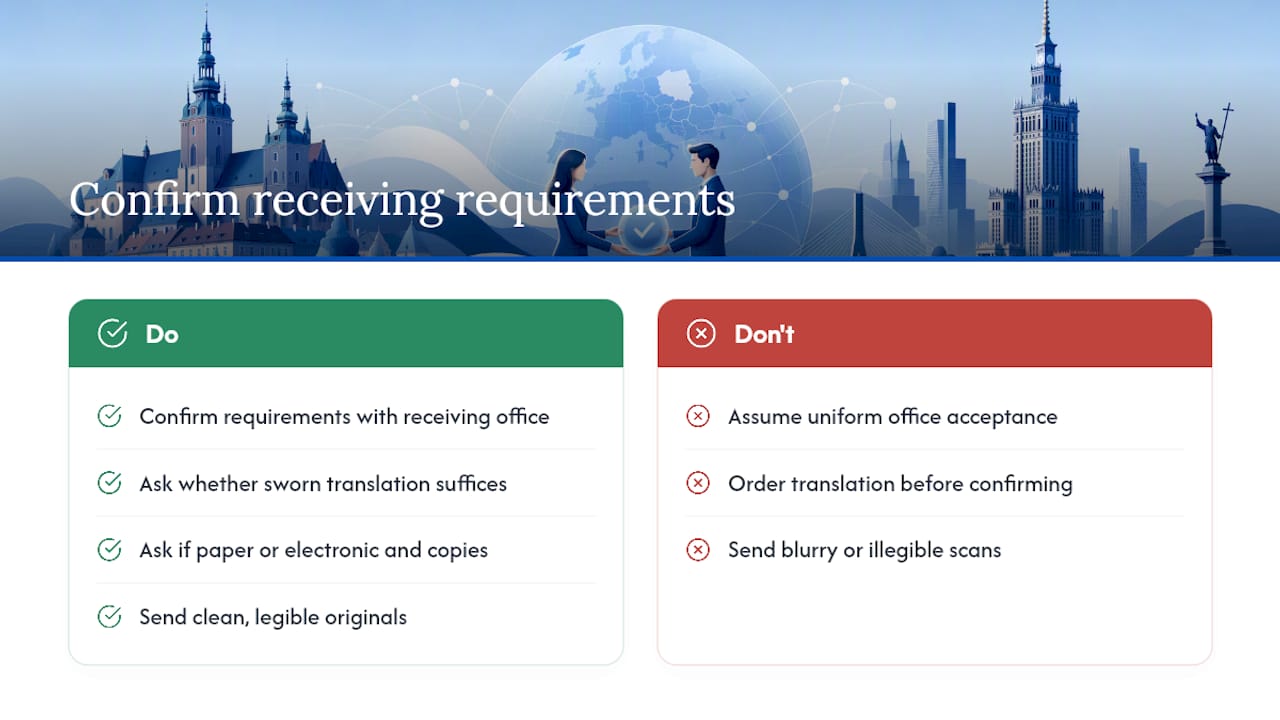
The fix is to confirm requirements with the receiving office before ordering, not after. Ask specifically: sworn translation or another format? Paper or electronic? How many copies? Does the cover page need to reference the case number or application reference? Five minutes on the phone with the right clerk saves days of reordering.
The other underestimated point: document quality. Translators are legally obligated to note anything illegible or missing in the source document. A blurry scan of a stamp does not disappear from the translation — it becomes a bracketed note saying the content was illegible, which some offices treat as a deficiency. Send clean originals.
Regal Consultancy's translation coordination service
Arranging a sworn translation while managing a relocation, a work permit application, or an international hire involves more moving parts than most people expect: sourcing the right translator for the language pair, confirming the receiving office's format requirements, organizing courier delivery of stamped originals, and tracking deadlines across multiple documents.
Regalconsultancy handles that coordination layer as part of its administrative and mobility support services for employers and individuals in Poland. The process: Regalconsultancy arranges quotes from registered sworn translators, confirms format requirements with the receiving authority, manages document pickup and delivery, and advises on whether notarization or apostille is needed alongside the translation. The sworn translator on the Ministry of Justice register issues every legally valid certified document. Regalconsultancy manages the logistics so you do not have to.
All documents are handled with strict confidentiality. To request translation coordination as part of a relocation or hiring package, visit Regalconsultancy or use the contact form to describe your document and receiving authority.
Sources
Use these sources to verify translators and read the legal framework before you order.
- Find legal translators and interpreters (Poland) — e-Justice portal
- Englaw
- Sworn translation in Poland: A Complete Guide for English Speakers — TłumaczeniaPrzysięgłe Wroclaw