

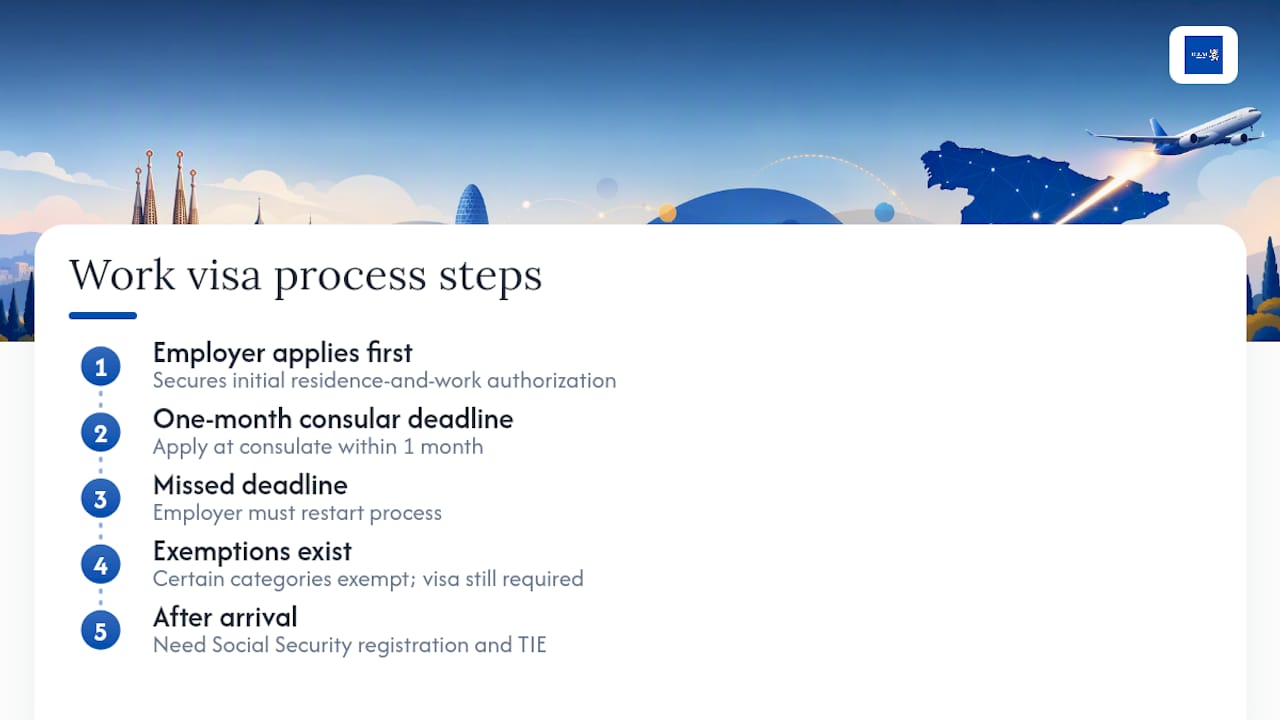
Your Spain work visa application cannot start until your employer in Spain secures an initial residence-and-work authorization on your behalf. This is the legal foundation of the entire process: no authorization, no consular visa application. The employer files with the Delegation or Sub-delegation of the Government (the Provincial Aliens Affairs Office), and once that office issues a favorable decision, the clock starts ticking for you.
Your immediate next step is simple. Contact your employer now and ask two things: whether they've filed the paperwork, and what the exact date is when they receive notification of approval. That date matters enormously, because you have a limited time from the day after notification to submit your visa application at the correct Spanish consulate. Two agencies govern this process from start to finish: the Provincial Aliens Affairs Office handles the domestic authorization, while the Spanish Ministry of Foreign Affairs (MAEC) oversees the consular visa stage.
Key Takeaways
A Spain work visa requires the employer to secure initial residence-and-work authorization first, after which the applicant has exactly one month to file the consular visa application.
| Point | Details |
|---|---|
| Employer files first | The employer must obtain initial residence-and-work authorization before any consular application is possible. |
| One-month windows apply twice | You have one month to file after notification, and the consulate has one month to decide. |
| Documents need legalization | Criminal records, medical certificates, and translations require apostilles or official legalization before submission. |
| Arrival isn't the finish line | Social Security registration and TIE application are both required after entering Spain to become fully authorized. |
| Regal Consultancy supports the full process | Regal assists employers and candidates with authorization paperwork, document legalization, and consular and TIE appointment coordination. |
Table of Contents
- Quick Checklist: Documents and Timing Before You Apply
- Which Spain Work Visa Route Fits Your Situation?
- Step-by-Step: From Employer Authorization to Your First Day at Work
- Getting Your Documents Right: Criminal Records, Contracts, and Legalization
- Do You Qualify for a Work Permit Exemption?
- What Will This Cost, and How Long Will It Take?
- Choosing the Right Consulate and Booking Your Appointment
- What Happens the Moment You Land in Spain
- How to Avoid the Most Common Refusal Triggers
- What We See Working With Candidates and Employers
- How Regal Consultancy Supports Your Spain Work Visa Application
- Frequently Asked Questions
- Sources
Quick Checklist: Documents and Timing Before You Apply
Before you touch a consular appointment system, get your paperwork in order. Missing one document or misreading the timing window is the single most common reason applications stall.
Here's what you'll need on hand:
- Valid passport with sufficient remaining validity and blank pages
- Completed national visa application form
- Passport-style photos meeting consular specifications
- The initial residence-and-work authorization issued to your employer
- Criminal record certificate covering the last 5 years of residence
- Medical certificate from an approved practitioner
- Certified translations and apostilles for any foreign-language documents
The timing sequence runs like this: your employer files in Spain, the Provincial Aliens Affairs Office issues a decision, your employer gets notified, and from the day after that notification you have one month to submit your consular visa application. The consulate then has its own legal decision period of one month, though this can be extended if they request additional documents or an interview.
Pro Tip: Start your translations and apostille requests the moment your employer files for authorization, not after they get approved. Legalization can take weeks, and you don't want it eating into your one-month consular window.
Which Spain Work Visa Route Fits Your Situation?
Not every non-EU worker goes through the same door. The route that applies to you depends on your job type, your employer, and sometimes your nationality.
- Residence and Employment Work Visa (TRA): the standard path for employed workers with a signed, stamped job contract and an initial authorization from the employer. This covers most factory workers, drivers, technicians, and tradespeople entering under a direct job offer.
- Residence visa with work permit exemption: governed by Article 88 and the Royal Decree framework, this route applies to specific categories, researchers hired by public institutions, intra-company transferees, and religious personnel, among others, who skip the standard work authorization but still need the correct residence visa.
- EU Blue Card: designed for highly skilled workers with a university degree or equivalent professional experience and a job offer meeting a minimum salary threshold. It often bypasses the labour market test entirely and grants more flexible intra-EU mobility than the standard employment visa.
- Seasonal worker visa: tied to a fixed-term agricultural or tourism contract, with shorter validity periods and different TIE requirements depending on the length of stay.
If you're only traveling for short business meetings or training under 90 days, you likely don't need any of these; that falls under visa-free short business visits, a category entirely separate from employed work visas.
Step-by-Step: From Employer Authorization to Your First Day at Work
The legal sequence has four distinct stages, and each one has its own responsible party and its own deadline.
- Employer files for authorization. Your employer submits the request for initial residence-and-work authorization to the Provincial Aliens Affairs Office. If your role isn't listed on the Shortage Occupations List, your employer must first run a labour market test, advertising the vacancy through public employment services and documenting genuine recruitment efforts before they can claim no qualified local candidate was available.
- Employer receives notification. Once the office issues a favorable decision, your employer must notify you of the exact date. This date is the trigger for your consular deadline.
- You apply at the consulate. You have one month from the day after notification to submit your national visa application, either in person or through an accredited representative depending on the consular district's rules. The consulate's legal decision period is one month from submission, though processing can extend if extra documentation or an interview is requested.
- Entry and registration in Spain. Once your visa is collected and you enter Spain within the validity window, your employer registers you with Social Security, and you apply for your TIE.
One month. That single figure appears twice in this process, once for your consular application deadline, once for the standard decision period, and missing either window can force your employer to restart the authorization from scratch.
Getting Your Documents Right: Criminal Records, Contracts, and Legalization
Document errors sink more applications than any other single factor, and the fixes are almost always avoidable with enough lead time.
Your criminal record certificate needs to cover the last five years of residence, or since your 16th birthday if you're under 21. If it's issued in a language other than Spanish, it needs official translation and either legalization or an apostille before the consulate will accept it. Consulates in some jurisdictions won't accept certificates older than three months, so timing this document late in your preparation window matters.

Your medical certificate should align with the WHO International Health Regulations 2005 standard, and some consular districts require you to use a specific approved doctor rather than any general practitioner.
Your work contract, stamped by the Foreign Nationals' Office, is usually part of your submission package, though some consulates accept a photocopy while others want the certified original. Check your specific consular district's checklist before your appointment.
- Passport validity should extend well beyond your intended stay, with several blank pages remaining
- Bring photocopies of every passport page used in prior travel, some consulates require this
- Confirm apostille requirements early since processing times for legalization vary by issuing country
Pro Tip: Call or email your consulate's visa section directly to confirm their exact document list before booking your appointment. Requirements shift by consular district even within the same visa category.
Do You Qualify for a Work Permit Exemption?
Some applicants skip the standard authorization process entirely. Article 88, backed by Royal Decree 1155/2024, exempts specific categories from the work authorization requirement, though they still need the correct residence visa and supporting paperwork.
- Researchers and technicians hired directly by public research institutions
- Intra-company transferees moving within the same corporate group
- Religious ministers and representatives of recognized faith organizations
- Certain government-to-government exchange program participants
The EU Blue Card sits in its own category. It requires a university degree or comparable professional experience and a job offer above a set salary threshold, and it often bypasses the labour market test that standard employment visas require.
Exemption from a work authorization does not mean exemption from the visa process itself. Every exempt category still needs the appropriate residence visa and consular documentation, and confusing an exemption with a free pass to skip paperwork is one of the most common reasons applications get delayed or refused.
Confirm your specific category with the consulate or immigration office directly. Royal Decree 557/2011 and Royal Decree 1155/2024 govern the fine print, and consular staff apply these rules with real variation by district.
What Will This Cost, and How Long Will It Take?
Consular fees vary by nationality and by consulate, since Spain applies reciprocity principles, some applicants pay more or less depending on what Spanish citizens would pay for an equivalent visa in their home country. Always check your specific consulate's published fee schedule rather than relying on a generic figure.
- Legal decision period: one month from consular submission, extendable if the consulate requests an interview or more documents
- Visa validity: commonly a 90-day entry window when the contract runs a full year, with different rules for seasonal or shorter contracts
- Passport handling: expect the consulate to retain your passport for the entire processing period
One month, twice over. That's the realistic minimum timeline you're working against, each stage of the consular filing and decision process has its own deadline. Build your travel plans around visa collection, not just the application date.
Choosing the Right Consulate and Booking Your Appointment
You must apply at the consulate covering your legal place of residence, not just any Spanish consulate that's convenient. Consular districts enforce this strictly, and applying in the wrong district is a fast way to get your application rejected outright.
- Verify your consular district on the Sede MAEC portal before booking anything
- Book your appointment as early as possible; some consulates open scheduling up to six months in advance
- Submission by an accredited representative is allowed in many districts, though minors typically require in-person attendance
- Bring proof of residence in the consular district, a lease, utility bill, or official registration document usually works
Pro Tip: If your consulate offers online appointment booking, set a calendar reminder for the moment slots typically open. Popular consular districts fill appointment slots within minutes.
Missing your visa pickup window can mean starting the collection process over, so confirm collection procedures the day you submit your application.
What Happens the Moment You Land in Spain
Entering Spain on your work visa is only the halfway point. Two more legal steps stand between you and being fully authorized to work.
- Your employer must register you with Spanish Social Security within the required days after your entry; this step is what actually activates your work authorization
- You must apply for your TIE (Tarjeta de Identidad de Extranjero) at the Foreign Nationals' Office or local police station, typically within one month of your Social Security registration
- Your visa entry stamp alone does not make you legally employable; Social Security enrollment and TIE registration both need to happen
One month. That's your window to apply for the TIE after Social Security registration, the same figure that governed your consular application, just applied to a different stage of the process. Bring your passport, visa, employment contract, and proof of address to both appointments, and check with your local immigration office since regional offices sometimes add their own procedural requirements.
How to Avoid the Most Common Refusal Triggers
Most refusals trace back to timing errors or paperwork technicalities, not to genuine ineligibility. Your employer's diligence matters as much as your own document prep.
- Missing the consular application window after notification
- Submitting certificates or contracts without proper legalization or certified translation
- Criminal record certificates that don't cover the full required period
- Failing to prove residence in the correct consular district
Pro Tip: Ask your employer for written confirmation of the exact notification date and a stamped copy of the authorization decision. Both documents protect you if there's ever a dispute about your one-month deadline.
Book your consular appointment the moment authorization looks likely, not after it's confirmed. And plan your travel schedule around passport unavailability, since you won't have it back until the consulate finishes processing.
What We See Working With Candidates and Employers
The bottlenecks we encounter most often aren't legal complexities, they're timing failures. A candidate waits two extra weeks to book a consular appointment because they assumed slots would still be open. An employer's HR team forgets to document their recruitment advertising, then scrambles to prove a labour market test that should have been documented from day one.
We typically advise employers to treat the authorization notification date as a hard deadline trigger, not a formality, and to hand candidates written proof of that date immediately. For candidates, our advice is blunt: start your translations and apostilles before you have anything else finalized. The paperwork bottleneck is almost always more predictable, and more avoidable, than people expect.
How Regal Consultancy Supports Your Spain Work Visa Application
Regal Consultancy is the alternative to navigating this process alone, cutting through the guesswork of employer authorization paperwork, document legalization, and consular appointment timing that trips up so many applicants.
Our support covers the full sequence: helping employers assemble the documentation needed for the initial residence-and-work authorization, coordinating certified translations and apostilles for criminal records and medical certificates, and guiding candidates through consular submission requirements specific to their district. Once you land in Spain, we assist with Social Security registration timing and TIE appointment scheduling, so nothing falls through the cracks between visa entry and full work authorization. Our focus stays on the sectors we know best: logistics, construction, transport, and manufacturing, and every case is handled with full confidentiality for both employer and candidate. If you're an employer preparing to sponsor a non-EU hire, or a candidate who's already received your authorization notification, visit Regal Consultancy's services page to get started on the next step.
Frequently Asked Questions
Who applies for the Spain work visa first, me or my employer? Your employer applies first. They must secure the initial residence-and-work authorization from the Provincial Aliens Affairs Office before you can submit anything at the consulate.
How long do I have to apply once my employer is notified? You have one month from the day after your employer receives notification of a favorable decision to submit your national visa application at the consulate.
Can I skip the work authorization step entirely? Only if you fall under a specific exemption category covered by Article 88 and Royal Decree 1155/2024, such as certain researchers or intra-company transferees. You'll still need the correct residence visa even if exempt from the standard work authorization.
What happens if I miss the one-month consular deadline? Missing the window can invalidate the authorization, forcing your employer to restart the process from the beginning. Treat the notification date as a hard deadline.
Does entering Spain on my visa mean I can start working immediately? No. You still need Social Security registration and a TIE application after arrival. The visa entry stamp alone doesn't authorize employment.
This article is general information, not a substitute for advice from a qualified lawyer. Consult a qualified legal professional about your own circumstances before acting on anything here.
Sources
- Employed worker in Spain - Migration and Home Affairs
- RESIDENCE AND EMPLOYMENT WORK VISA - TRA (Consulate guidance)