

If you're moving to Poland for a job or a research post, you'll almost certainly need a temporary residence and work permit or, if you're joining a university or institute, a researcher-specific temporary residence permit. Both are filed the same way: through the MOS portal, followed by an in-person appointment at your regional voivodeship office. If you've already spent five years living legally and continuously in Poland, you may qualify instead for permanent residence or a long-term EU resident permit.
Before anything else, do three things this week:
- Open a MOS account. MOS (Moduł Obsługi Spraw) is the government's electronic system for preparing and submitting residence applications, and it's where your whole case starts.
- Check your salary against the threshold. For most work-based temporary permits, your gross monthly pay must reach PLN 4,806, regardless of whether you work full or part time.
- Gather your passport and proof you're staying legally. You want this ready the moment you file, because a properly filed application before your current stay expires is what keeps your status intact while officials review it.
That last point matters more than most applicants realize. File your paperwork on time, and Poland's entry and residence rules allow the voivode to stamp your passport confirming legal stay until a final decision is made. Miss that window, and you're suddenly an overstayer while your case sits in a queue. The system is built around punctuality, not paperwork perfection, though you'll need both eventually.
Key Takeaways
Most foreign workers and researchers in Poland need a temporary residence and work permit filed through MOS, meeting the PLN 4,806 minimum remuneration threshold, with a complete document file submitted in person at the voivodeship office.
| Point | Details |
|---|---|
| Start with MOS | Create your account and select the correct appendix before gathering documents. |
| Check the salary threshold | Confirm gross monthly pay reaches PLN 4,806, combining employers if needed. |
| Build a complete file | Include passport, contract, insurance, accommodation proof, and certified translations. |
| File before expiry | Submitting on time preserves legal stay via the certificate of on-time submission. |
| Consider paid support | Regal Consultancy offers document audits, MOS filing help, and appeal support for complex cases. |
Table of Contents
- Which Residence Permit in Poland Fits Your Situation?
- Who Qualifies, and What the Rules Actually Require
- What Documents You Need Before You File
- How to Apply: The MOS and Voivode Process Step by Step
- Processing Times, Fees, and What to Expect While You Wait
- After the Decision: Cards, Renewals, and Reporting Changes
- Common Mistakes That Delay or Sink an Application
- A Practical Checklist Before You File
- Get Help Filing Your Residence Permit Application
- Frequently Asked Questions
- Sources
Which Residence Permit in Poland Fits Your Situation?
Poland issues several distinct residence permits, and picking the wrong category wastes months. The permit you need depends on why you're here, how long you plan to stay, and whether you've already built up years of legal residence.
A few distinctions decide which box you fall into:
- The temporary residence and work permit is the default route for most foreign employees. It's employer-specific, meaning a job change usually triggers a fresh application rather than a simple update.
- The EU Blue Card exists for highly qualified professionals and carries somewhat more flexibility around switching employers partway through validity, though it still demands a defined role and salary level.
- The researcher permit runs through a hosting agreement with a Polish research institution. EURAXESS Poland supports incoming researchers navigating that agreement and the residence process alongside it, and it's worth contacting them early if you're arriving under an academic contract.
- Family reunification permits piggyback on a sponsor's status, so their validity and conditions mirror whatever the sponsoring family member holds.
- Permanent residence and the long-term EU resident permit both require years of prior legal residence, but they aren't identical: the long-term EU resident status carries EU-wide mobility implications that plain permanent residence doesn't.
Who Qualifies, and What the Rules Actually Require
Eligibility for a temporary residence and work permit rests on a short list of conditions, and MOS guidance spells out all of them plainly:
- You must be legally present in Poland at the moment you file, or filing from abroad through the correct consular channel.
- The purpose you declare has to match what you're actually doing. If you say you're coming for employment, your appendix and contract need to back that up.
- You need valid health insurance covering your stay.
- Applications and biometrics are submitted in person. There's no fully remote path for the voivode appointment stage.
- Your stated remuneration can't sit below what a comparable Polish employee would earn for the same role.
That last rule is where the minimum wage figure comes in directly. Work-based temporary permits generally require gross pay of at least PLN 4,806 per month, whether you're working full time or part time. If you hold multiple part-time contracts, the appendices from each employer typically get combined to check whether your total reaches that floor. Confirm the current figure on gov.pl before filing, since minimum wage numbers get revised.
Permanent residence and the long-term EU resident permit ask for something different: time, not just income. The long-term EU resident route generally requires at least five years of uninterrupted, legal, and stable residence before you can apply, and the permit itself is indefinite even though the physical card only lasts five years and needs periodic reissuing. Authorities also tend to look past a single month's income when assessing long-term eligibility, favoring a track record of regular, stable earnings over several years rather than one strong payslip.
The legal foundation for all of this sits in Poland's Act on Foreigners. The voivode of your region decides most applications, and if you're refused, the Head of the Office for Foreigners (Urząd do Spraw Cudzoziemców) hears appeals.
What Documents You Need Before You File
Missing paperwork is the single biggest reason applications stall. Build your file around these categories before you touch MOS.
| Document category | What's typically required | Notes |
|---|---|---|
| Identity | Valid passport, passport-style photos | Bring the original passport to your appointment, not just a scan |
| Purpose of stay | Employment contract or hosting agreement, employer appendix showing remuneration | Appendix must show pay meeting the applicable threshold |
| Insurance | Proof of health insurance valid for the residence period | Employer-provided or private coverage both work |
| Accommodation | Rental agreement or zameldowanie (address registration) confirmation | Some card procedures require current registration |
| Legal stay evidence | Current visa, prior residence card, or entry stamp | Shows you were legal in Poland when you filed |
| Fee payment | Stamp duty receipt | Payment proof usually needs to accompany the file |
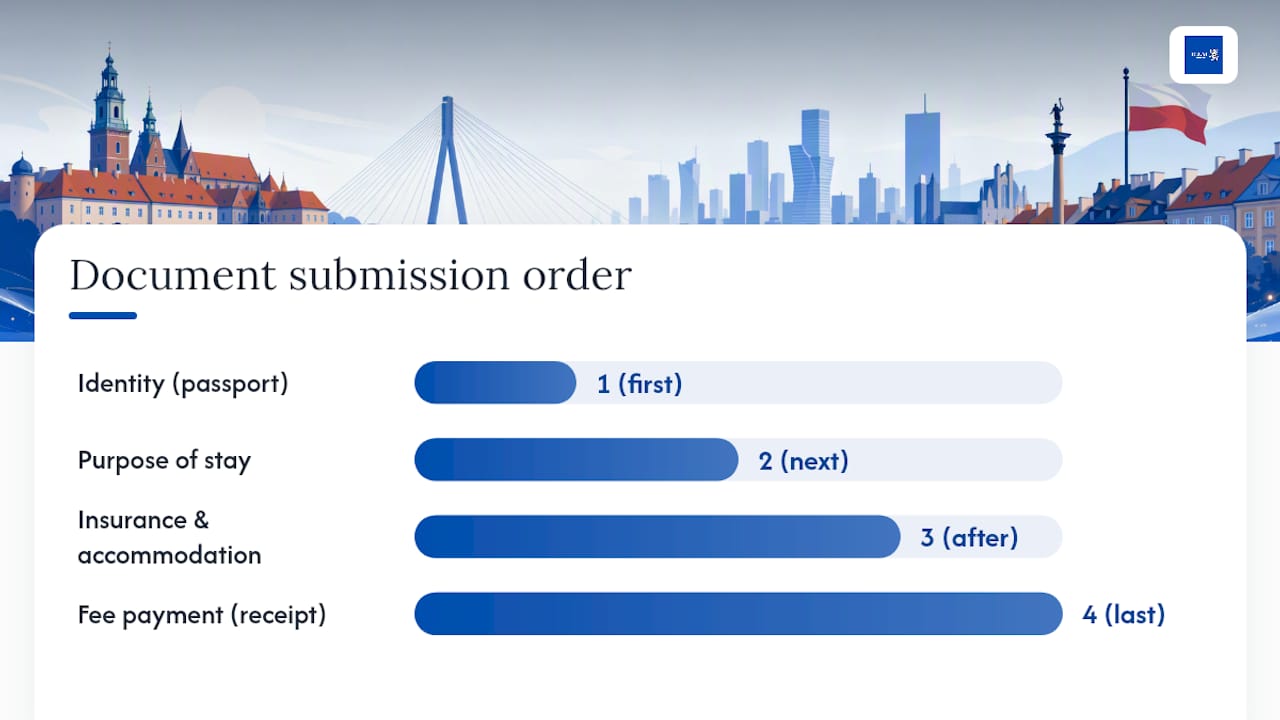
Certified translations matter here. Any document not issued in Polish or English generally needs a certified Polish translation attached, and officials expect originals at the appointment even when you've uploaded scans through MOS. Keep your file ordered the way the appendix numbering expects it: passport first, purpose-of-stay documents next, insurance and accommodation proof after that, payment receipt last. A disorganized stack of paper is a common, avoidable reason clerks ask for a second visit.
Pro Tip: If you're combining income from more than one part-time employer to clear the PLN 4,806 threshold, ask each employer to state gross monthly remuneration explicitly in their appendix. Vague wording like "salary as agreed" without a figure is one of the fastest ways to trigger a request for clarification.
A printable version of this checklist, organized by permit type, saves real time when you're juggling multiple appendices and translations at once.
How to Apply: The MOS and Voivode Process Step by Step
The application sequence is consistent across almost every permit category. Here's how it runs in practice.
- Create your MOS profile. Register on the MOS portal using a trusted profile or qualified signature.
- Select the correct application and appendices. Temporary work permits, researcher permits, and family reunification each use different appendix forms. Picking the wrong one is a common cause of rejected filings.
- Attach your supporting documents. Upload scans of your passport, contract, insurance, and accommodation proof directly into the relevant MOS fields.
- Print and sign the completed application. MOS generates a document that needs a wet signature before submission.
- Book your voivodeship office appointment. Availability varies by region and by season; booking early avoids a long wait for a slot.
- Attend in person with originals and payment proof. Bring your physical passport, signed application, and stamp duty receipt.
- Provide fingerprints. Biometric data collection happens at this appointment for most permit types.
- Receive your certificate of on-time submission. This document, described in official procedural guidance, confirms you filed before your previous stay expired and preserves your legal status while the case is decided.
MOS trips up a lot of first-time users in predictable ways. The most frequent error is selecting the wrong appendix template for the permit category, since the portal's naming conventions aren't always intuitive to someone unfamiliar with Polish administrative terms. Another common snag is uploading documents in formats the system rejects, usually because scans exceed size limits or aren't saved as standard PDFs. Double-check the specific appendix required for your case type before you start filling fields, and save your work frequently since MOS sessions can time out.
Once a decision is positive, you'll be asked to return to collect your personalized residence card and, per MOS guidance on the process, most applicants only visit the voivodeship office twice total: once to submit, once to collect. Extra visits happen only if officials need clarification.
Processing Times, Fees, and What to Expect While You Wait
Costs are modest compared to the stakes involved, but they add up across stamp duty, card printing, and registration fees.
Decision timelines vary by case complexity and regional office backlog, though official guidance frames a standard target window that can extend when the office requests supplementary documents or when your file needs verification from another authority. Filing a complete, correctly organized package from day one is the single biggest lever you have over how quickly your case moves, since incomplete submissions restart or pause that clock.
Once your card is approved, expect roughly a month between payment, registration, and the card actually being ready to collect, based on regional office processing notes. You must collect it in person; it isn't mailed.
Pro Tip: Save every MOS case number, payment receipt, and delivery confirmation in one folder from day one. If your case stalls past the expected window, having your case number ready when you call or email the voivodeship office turns a vague inquiry into a specific, answerable one.
After the Decision: Cards, Renewals, and Reporting Changes
Getting a positive decision isn't the finish line. What happens next depends on which permit you were granted.
- Temporary permits produce a residence card valid for the same length as the permit itself, generally up to three years.
- Permanent residence cards are valid for 10 years, even though the underlying status itself is indefinite.
- Long-term EU resident cards are valid for 5 years, also despite indefinite underlying status.
- Humanitarian or subsidiary protection cases often carry shorter card validity tied to the specific protection status granted.
Renewal isn't automatic. You'll need to reapply before your current card expires, using largely the same document set you submitted originally, refreshed where needed (updated employment contract, current insurance, proof of continued residence). Filing your renewal well before expiry, rather than in the final week, avoids any gap in lawful status.
If you lose your job or switch employers while holding a temporary work-based permit, you're generally required to notify the voivode, and depending on your permit type, a new employer may trigger fresh procedure requirements rather than a simple update to the existing card. Ignoring this step is one of the more common reasons a permit gets questioned at renewal time, since authorities check whether your declared purpose of stay still matches reality.
One quirk worth flagging clearly: the certificate confirming your on-time application preserves your legal stay inside Poland, but it does not automatically let you re-enter the country if you travel abroad before your permit is granted. Plan any international trips carefully during the waiting period, and confirm your specific situation with the voivodeship office before booking travel.
Common Mistakes That Delay or Sink an Application
Most refusals and delays trace back to a handful of repeat offenders, and nearly all of them are preventable.
Incomplete appendices top the list, particularly employer remuneration sections left vague or unsigned. Close behind is picking the wrong MOS form for your specific permit type, which sends your case down the wrong administrative track before you've even reached the appointment stage. Missing original documents at the in-person appointment is another frequent snag; scans satisfy MOS uploads, but officials at the voivodeship office expect to see the real passport and contract in hand.
Uncertified translations cause their own headaches. A document in a language other than Polish or English, submitted without a certified translation attached, often gets kicked back for resubmission. Gaps in proof of continuous income or accommodation registration create similar friction, especially for long-term or permanent applications where authorities are explicitly checking for stability over time rather than a single snapshot. And because the burden of proof sits with the applicant throughout the proceeding, failing to notify the voivode about a job change or address change is one of the more consequential errors, sometimes triggering a negative decision or a withdrawal procedure rather than a simple correction request.
Pro Tip: Before submitting through MOS, open every uploaded document one more time and confirm file size, format, and legibility. For translations, use a sworn translator listed with a Polish court, since informal translations are routinely rejected even when the content is accurate.
A Practical Checklist Before You File
Run through this list before you book your voivodeship appointment:
- Confirm your MOS account is set up and you've selected the correct appendix for your permit type.
- Verify your declared remuneration meets or exceeds the current PLN 4,806 threshold, aggregated across employers if needed.
- Secure your zameldowanie (address registration) confirmation, since some card procedures require it.
- Double-check every document has a certified Polish translation where the original language isn't Polish or English.
- Book your appointment as early as your regional office allows, since slots fill up fast in busy periods.
- Save your MOS case number and set a reminder to follow up if you haven't heard back within the expected window.
Some situations genuinely call for outside help rather than muddling through solo. If you're combining income from multiple employers and need the math to hold up under scrutiny, if you're appealing a negative decision within the 14-day window, if your card is stuck at the collection stage and you need someone to chase it, or if language gaps are slowing down your document prep, a paid administrative service can shorten the distance between filing and approval. That's a genuinely different calculation than someone with a single straightforward employment contract and a complete file, and it's worth being honest with yourself about which category you fall into before you spend weeks stuck in avoidable back-and-forth.
What most applicants get wrong before they even start
Most of what goes sideways in this process isn't about the law being unclear. It's about timing and paperwork discipline. A pattern shows up again and again: someone secures a job offer, assumes the residence side will sort itself out once they arrive, and then finds themselves scrambling to get a zameldowanie certificate or a certified translation two weeks before their current stay expires.
The zameldowanie step in particular catches people off guard. It sounds like a minor registration formality, but if a card procedure needs it and you haven't registered your address at the right municipal office, you're stuck waiting on a document you could have gotten weeks earlier with almost no effort. Translation bottlenecks follow a similar pattern: sworn translators in smaller cities book up, and a document that would've taken two days to translate in January can take two weeks in a busy September when university terms start and hiring season peaks simultaneously.
None of this reflects a broken system. It reflects a process that rewards early preparation and punishes procrastination in fairly predictable ways. Start your document collection the day you accept a job offer or research position, not the week your visa runs out.
Get Help Filing Your Residence Permit Application
Regal Consultancy exists for exactly the moments this guide flags as genuinely hard: aggregating multi-employer income to clear the remuneration threshold, appealing a negative decision before the 14-day window closes, or chasing a stuck card collection when the voivodeship office has gone quiet. Instead of piecing together MOS forms, translation requirements, and appointment logistics on your own, you get a document audit, direct MOS filing support, and appointment coordination handled by people who do this daily.
The process is straightforward: a consultation to understand your situation, a document audit to catch gaps before they become rejections, then application support through submission and collection. This is a fee-based service, disclosed upfront, no surprises. If you'd rather have someone confirm your file is complete before you commit to a voivodeship appointment slot, reach out through Regal's services page and start with a document review.
Frequently Asked Questions
Do I need a job offer before applying for a residence permit in Poland? For a temporary residence and work permit, yes. Your application ties directly to a specific employer and role, and the appendix showing your remuneration comes from that employer.
Can I work while my residence permit application is pending? Whether you can continue working depends on your existing status when you file. If you filed on time and hold a certificate confirming legal stay, your existing work authorization generally continues, but confirm your specific case with the voivodeship office since rules vary by prior permit type.
How long does a temporary residence and work permit last in Poland? Up to three years, though many first-time permits are granted for shorter periods, and renewal requires a fresh application before expiry.
What's the difference between permanent residence and the long-term EU resident permit? Both require around five years of legal, continuous residence and both grant indefinite status, but the long-term EU resident permit carries additional mobility rights across the EU that plain permanent residence doesn't include. The physical cards also differ: permanent residence cards last 10 years, long-term EU resident cards last 5.
Can I travel outside Poland while my application is being processed? Be cautious here. The certificate confirming your on-time submission preserves your legal stay inside Poland, but it doesn't guarantee re-entry if you leave the country before a decision is issued. Confirm your specific situation with the voivodeship office before booking any international travel.
What happens if my residence permit application is refused? You can appeal to the Head of the Office for Foreigners within 14 days of receiving the negative decision. Many refusals stem from incomplete files or unreported changes in employment, so a careful review of what triggered the refusal often shapes the appeal strategy.
Does a Polish residence permit let me travel within the Schengen Area? Yes. A valid residence card combined with your travel document allows short stays of up to 90 days in any 180-day period across the Schengen Area, the same short-stay allowance that applies to most non-EU travelers.
Where do I submit my residence permit application in Poland? You prepare and submit the application through the MOS portal, then attend an in-person appointment at the voivodeship office covering your place of residence, where you'll present originals and provide fingerprints.